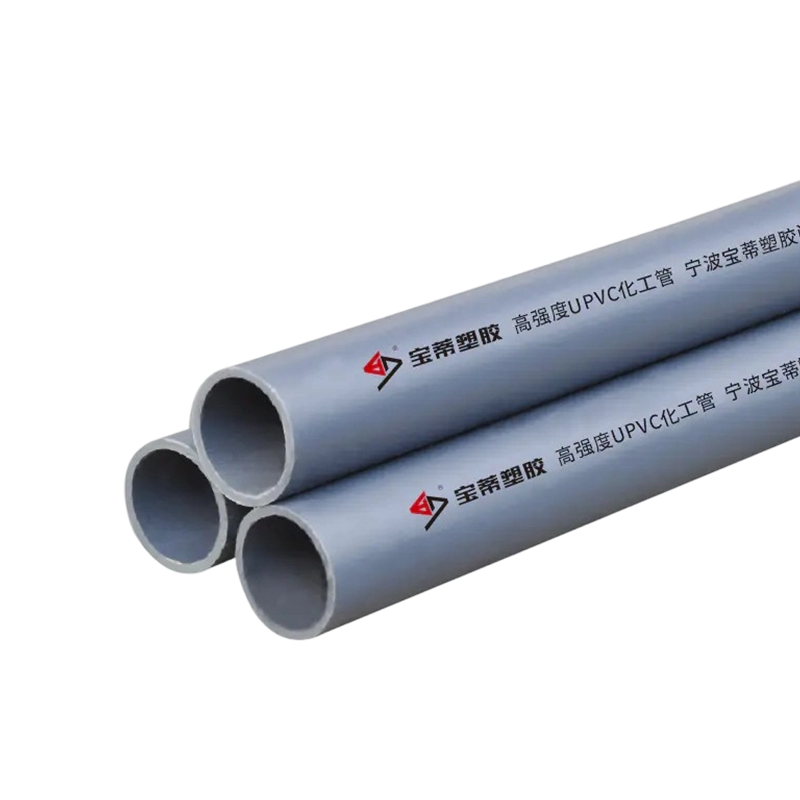
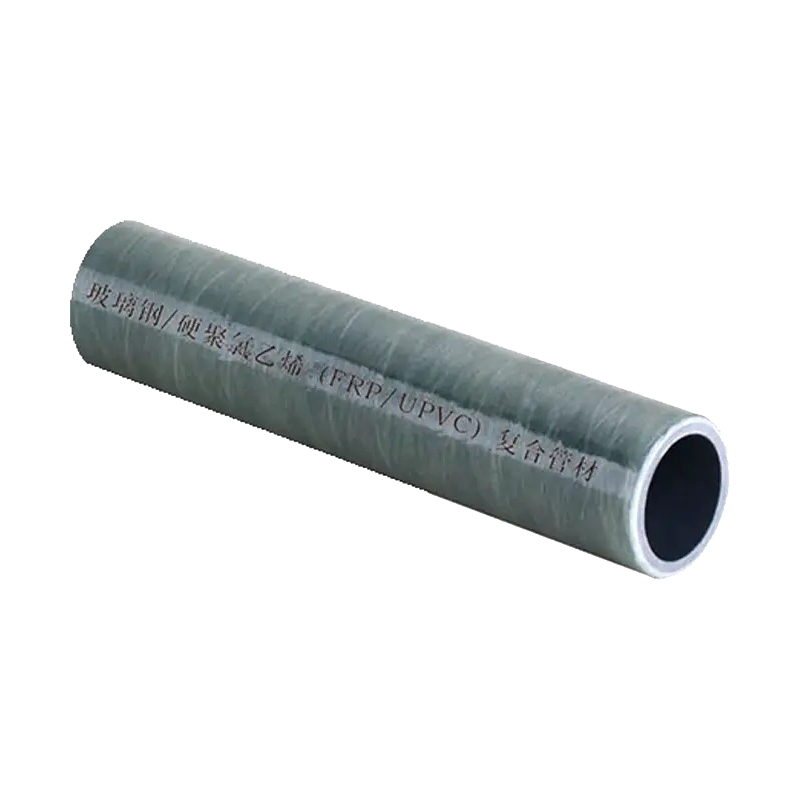
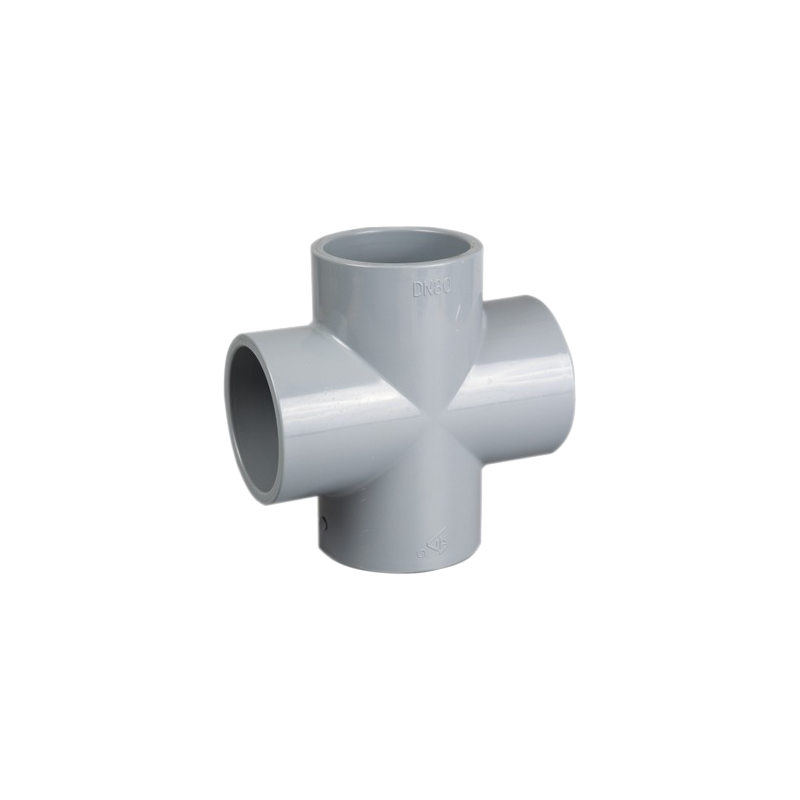
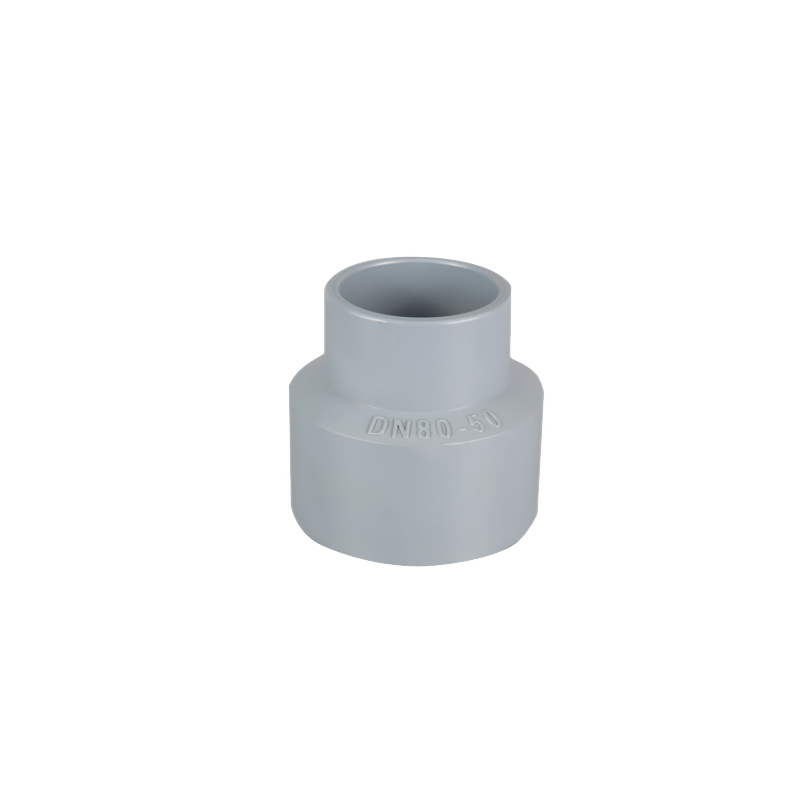
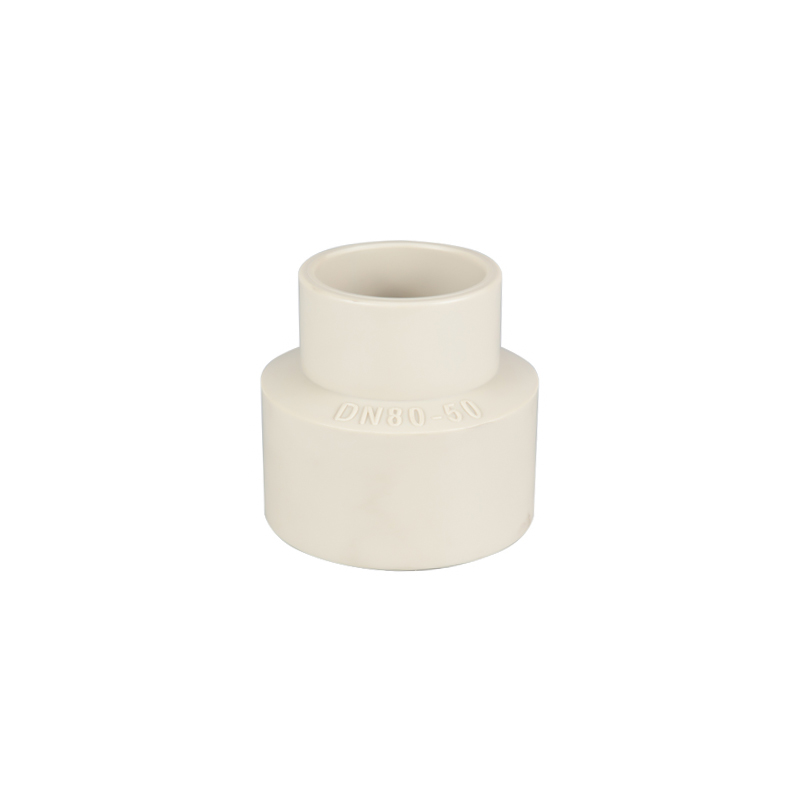
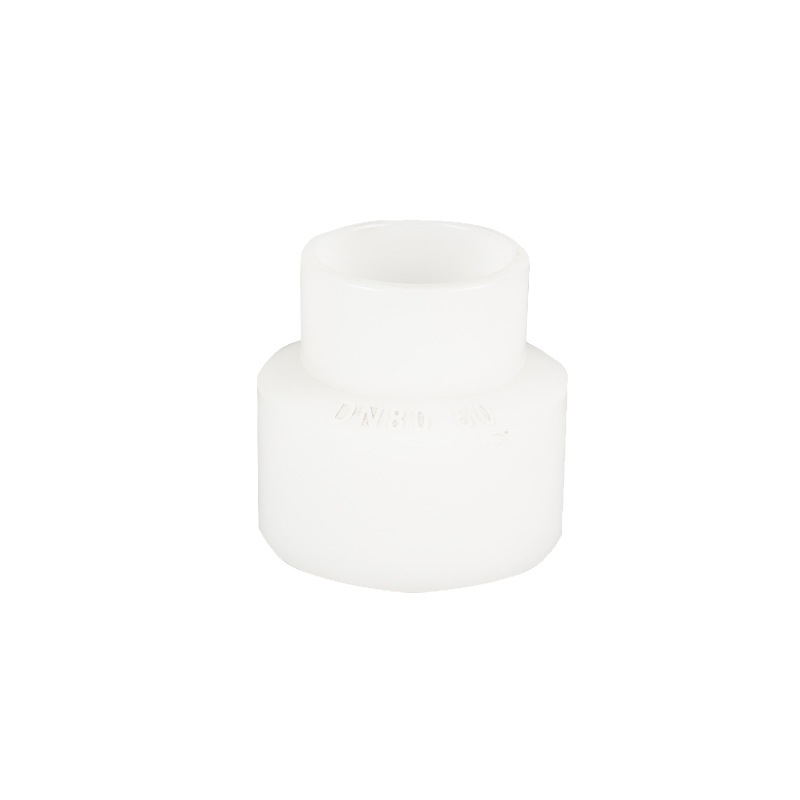
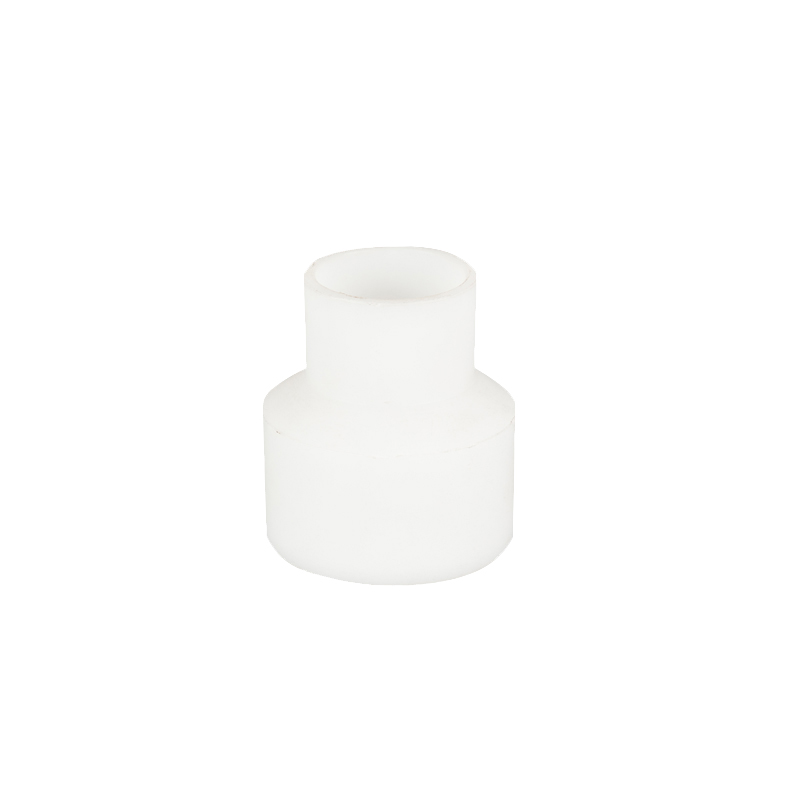
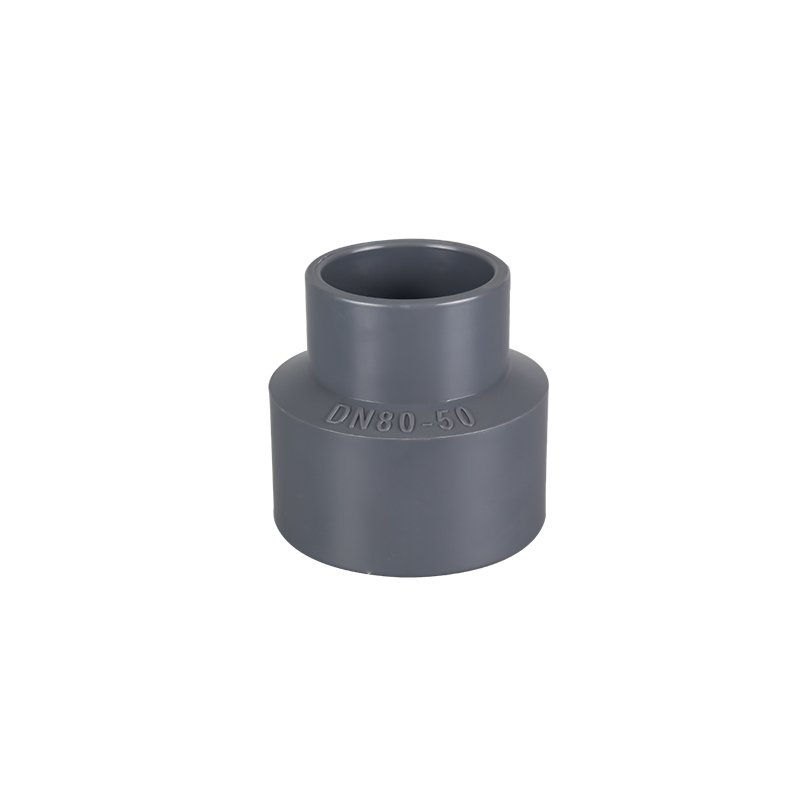
A Plastic Pipe Fitting Reducer connects two pipe sections of different diameters in a straight run, produced either as a concentric reducer (both centerlines aligned) or an eccentric reducer (one wall flat, the opposite side sloped, offsetting the centerlines). The choice between these two geometries is a functional engineering decision, most critically at pump suction connections, rather than an interchangeable option left to whichever the installer happens to have on hand.
Ningbo Baodi Plastic Valve Co., Ltd. has supplied plastic piping fittings alongside its pump-connected valve product lines since expanding into industrial plastic pipes and fittings in 2006, with reducers frequently specified at pump suction and discharge transitions across water treatment and chemical processing projects for the company's international distributor and contractor clients.
Concentric Reducer
Tapers symmetrically around the full circumference, keeping both pipe centerlines aligned. This is the standard geometry for general pipeline size transitions where air accumulation and pump suction effects are not a governing concern — the majority of size transitions in a typical industrial or water treatment system fall into this general category, where a concentric reducer's simpler, symmetric geometry is entirely adequate and often more economical to produce than an eccentric equivalent. A mid-line diameter change on a horizontal process line with no pump connection nearby, for example, is a straightforward concentric-reducer application in the large majority of cases, since neither the air-pocketing concern relevant to pump suction nor the invert-level concern relevant to gravity drainage typically applies.
Eccentric Reducer
Keeps one side of the pipe wall flat while the opposite side slopes to accommodate the diameter change, offsetting the two centerlines. Installation orientation of the flat side is a specified functional requirement, not an installer's discretion, and getting this orientation wrong effectively converts the eccentric reducer into a geometry that fails to deliver the specific benefit it was selected for in the first place, even though the fitting itself remains dimensionally correct and undamaged.
Flat-side-up: used on pump suction lines to prevent air from collecting at the top of the transition, which would otherwise reduce usable flow area and disturb the flow profile entering the pump — a recognized contributor to cavitation risk. When a larger suction pipe transitions down to a smaller pump inlet connection using a concentric reducer instead, the symmetric taper creates a high point at the top of the transition where the pipe diameter is reducing; any air present in the line, whether entrained in the fluid or introduced during startup and priming, tends to migrate to this high point and can accumulate there over time, effectively reducing the cross-sectional area available for liquid flow at exactly the location where consistent, air-free flow into the pump matters most.
Flat-side-down: used in gravity or drainage-flow applications to maintain a consistent invert level through the transition and avoid sediment pocketing at the pipe bottom. In a gravity system, the invert — the lowest point of the pipe's internal cross-section at any given point along the run — governs how the flow behaves at low fill levels and how effectively any settled particulate matter can be carried through the transition rather than accumulating there. A concentric reducer in this application would create a step-up in the invert level at the transition, providing exactly the kind of low-velocity pocket where sediment tends to accumulate.
Geometry Selection Reference
| Type |
Centerline |
Function |
Application |
| Concentric reducer |
Aligned |
General size transition |
Most process and utility lines |
| Eccentric reducer, flat-up |
Offset |
Prevents air pocketing |
Pump suction lines |
| Eccentric reducer, flat-down |
Offset |
Maintains invert level |
Gravity drainage transitions |
NPSH and Pump Suction Considerations
Pump suction performance is governed in part by available Net Positive Suction Head (NPSH), a measure of how much pressure margin exists at the pump's suction inlet above the fluid's vapor pressure at the operating temperature. When available NPSH drops too close to the pump's required NPSH — the minimum margin the pump itself needs to operate without the fluid vaporizing locally inside the impeller — cavitation can occur, producing characteristic symptoms including noise, vibration, reduced flow output, and accelerated wear on the impeller and pump casing.
A concentric reducer at a pump suction inlet can allow air to collect at the transition's high point, effectively reducing usable flow area and disturbing the flow profile entering the pump — both factors that contribute to cavitation risk independently of whether the system's calculated NPSH margin, based purely on elevation, pipe friction and vapor pressure, would otherwise appear adequate on paper. A flat-side-up eccentric reducer avoids creating this high point, which is why it is the standard specification at pump suction transitions rather than a design preference that could reasonably go either way depending on the engineer's taste. This recommendation appears consistently across pump manufacturer installation guidance and general piping design references precisely because the failure mode it prevents is a well-documented and recurring one in field installations.
Velocity and Erosion Effects
Reducing pipe diameter increases fluid velocity for the same flow rate, raising friction loss and, in some services, erosion risk downstream of the reducer, following the same basic principle that governs velocity increases at any diameter reduction in a piping system. Enlarging pipe diameter reduces velocity, which in slurry or particulate-laden applications can reduce the fluid's ability to keep solids in suspension — a factor that should be checked against the target suspension velocity for the specific particulate size and density involved before specifying an enlargement, since a reduction in velocity that seems modest on paper can, in some slurry compositions, be enough to allow settling that would not have occurred at the higher velocity in the smaller pipe.
Taper angle affects turbulence independently of these velocity effects: a longer, more gradual taper produces less flow disturbance at the transition than a short, abrupt one, at the cost of additional installation length — a specification worth making in erosion-sensitive or high-velocity service, where the incremental cost and space of a longer taper is generally justified by reduced turbulence-related wear and lower localized pressure loss at the transition itself.
Installation Requirements
Orientation verification: eccentric reducer flat-side orientation should be confirmed during installation inspection, since incorrect orientation negates the geometry's intended function entirely and is not detectable from the part number alone — a reducer installed with the flat side down at a pump suction, when flat-side-up was required, looks correct on a superficial inspection and will only reveal the problem once the pump begins experiencing the cavitation symptoms the correct orientation was meant to prevent, by which point diagnosing the root cause may take longer than it would have taken to verify orientation during initial installation.
Support at the transition: a reducer changes diameter and, in eccentric designs, centerline alignment, which can introduce localized stress; support should be provided on both sides of the fitting, particularly for eccentric reducers where the offset centerline can introduce a bending moment at the transition that a symmetric concentric reducer, all else equal, would not experience to the same degree.
Straight-run allowance: where the reducer feeds a pump or flow meter, sufficient straight-pipe length before and after the fitting supports flow-profile stabilization, following the same underlying principle discussed in relation to elbow-adjacent instrumentation and pump connections — a reducer, like an elbow, disturbs the flow profile at the point of the diameter change, and this disturbance requires distance downstream to settle before reaching devices sensitive to inlet flow uniformity.
Material Options
PVC reducers serve ambient-temperature water treatment and general chemical-transfer transitions, representing the most commonly specified material for standard municipal and general industrial applications where neither extreme temperature nor aggressive chemical exposure is a factor. CPVC extends the same geometry principles into hot water and higher-temperature applications while retaining a broadly similar installation approach to PVC. PP reducers, typically fusion-joined, suit acid, alkaline and wastewater systems, and the fusion joint itself provides a continuous, homogenous connection at the transition without introducing a separate solvent-cement bond line. PVDF reducers serve aggressive chemical and high-purity fluid transitions requiring broad chemical resistance, frequently specified in specialty chemical processing where both purity and chemical compatibility are simultaneously critical at the point of size transition.
Suction Side vs Discharge Side: Different Rules Apply
The eccentric, flat-side-up recommendation discussed above applies specifically to pump suction transitions, where preventing air accumulation ahead of the impeller is the governing concern. On the discharge side of a pump, where fluid is being pushed away from the pump rather than drawn toward it, the air-accumulation risk that drives eccentric reducer selection at suction is generally much less significant, since the discharge line typically operates at positive pressure throughout and any entrained air is being actively pushed along with the flow rather than accumulating at a low-velocity high point the way it can on the suction side, particularly during startup or at reduced flow.
This means a concentric reducer is frequently acceptable, and sometimes preferred for simplicity and cost, on a pump discharge size transition, even in an installation where the suction side requires an eccentric reducer. Buyers and installers who default to using eccentric reducers throughout a pump installation, out of an abundance of caution or simply because that is what was specified for the suction side, are not creating a functional problem by doing so, but they may be adding unnecessary cost, since eccentric reducers are frequently more expensive to produce than an equivalent concentric unit due to the more complex tooling and additional dimensional verification the offset geometry requires. Confirming which side of the pump actually requires the eccentric geometry, rather than applying it uniformly to both suction and discharge as a blanket precaution, is a straightforward way to control project cost without compromising the specific engineering benefit the eccentric geometry provides where it is genuinely needed.
Common Specification Errors
The most frequent and consequential specification error involving reducers is ordering a concentric reducer for a pump suction application without recognizing that an eccentric, flat-side-up unit was actually required — this error is compounded by the fact that a concentric reducer is often the default catalogue item and the lower-cost option, making it an easy and seemingly reasonable choice for a buyer or installer who is not specifically aware of the NPSH and air-accumulation implications discussed above. A related error is ordering the correct eccentric reducer type but failing to specify or clearly communicate the required flat-side orientation to the installer, leaving the orientation decision to be made in the field without the underlying engineering rationale being understood at the point of installation.
Ningbo Baodi Plastic Valve Co., Ltd. has fielded procurement inquiries where a buyer's initial request specified only nominal size and material for a reducer intended for pump suction service, without indicating the geometry or orientation requirement, and has worked with such buyers to confirm the correct specification before production — an example of the kind of technical clarification that a manufacturer with direct valve and pump-connection experience, drawing on the company's history since 1979, can provide during the order confirmation process rather than simply producing to the literal, incomplete specification as submitted.
Procurement Specification
Buyers specifying reducers for pump suction applications should state concentric or eccentric geometry and the required flat-side orientation explicitly at the point of order — this is a functional requirement that should not be left for field determination. Both end sizes, connection method, pressure/temperature rating, and taper length (where erosion-sensitive service requires a gradual transition) should also be confirmed. Distributors supplying pump installation contractors typically stock eccentric reducers separately from concentric reducers across common size combinations, given their distinct application requirements and the risk of a mix-up if both types are stocked without clear separation and labeling.
Ningbo Baodi Plastic Valve Co., Ltd. exports to more than 60 countries with ISO 9001, ISO 14001 and ISO 45001 certification supporting reducer orientation and dimensional accuracy for pump and valve packages shipped internationally, producing reducers across the full PVC, CPVC, PP and PVDF material range to match the pump and process piping materials used across the company's diverse export project base.