A plant maintenance engineer in a specialty chemical workshop was replacing a dosing pump's mechanical seals for the third time in six months. The pump handled dilute hydrochloric acid, and every time it shut down, the liquid column in the vertical riser fell back and spun the impeller in reverse. The piping was UPVC, the line pressure was modest, and the real fault was not the pump. The check valve on the discharge line had been removed weeks earlier because it kept dripping, and nobody had replaced it. When the engineer sat down to order a new one, the first question on the requisition was straightforward: what are the three main types of check valves, and which one belongs on this line?
That question appears constantly in industrial maintenance, in pipe system design, and in replacement part procurement. It is not an academic classification. The type of check valve controls how much flow resistance the line will see, whether the valve can handle dirty or viscous media, whether it can be installed in a vertical riser, and whether it will slam shut and create a pressure surge when the pump stops. In a thermoplastic piping system the decision matters even more, because the valve body, the flanges, and the pipe itself are plastic. A poorly matched check valve can create water hammer that cracks a flange, loosens a solvent-cemented joint, or fatigues the threaded connection of a flow meter.
The purpose of this article is to give a practical answer to that question. It explains the three main types of check valves, compares them on pressure drop, orientation, water hammer tendency and media compatibility, and then moves into material selection, installation mistakes, industry applications, and specification advice that a manufacturer's engineer actually uses on the shop floor.
The Three Main Types of Check Valves at a Glance
The conclusion first: the three main types of check valves are the swing check valve, the ball check valve, and the lift check valve. These three groups are defined by the moving element that blocks reverse flow, and every other check valve design is either a variation of one of these three or a special-duty derivative. A wafer check valve, for example, is a twin-disc variation optimized for short installation lengths. A foot valve is a ball check valve with an integrated strainer for pump suction lines. A silent check valve adds a spring and a guided disc, which is a lift-check concept. Understanding this grouping is the shortest path to a correct specification.
All check valves work automatically, without an actuator, lever, or external power source. Forward flow opens the valve; reverse flow or gravity closes it. What separates the three main types is the geometry of the closing element and the path the fluid must take through the body. These differences produce measurable differences in pressure drop, reliability, closing speed, and acceptable orientation.
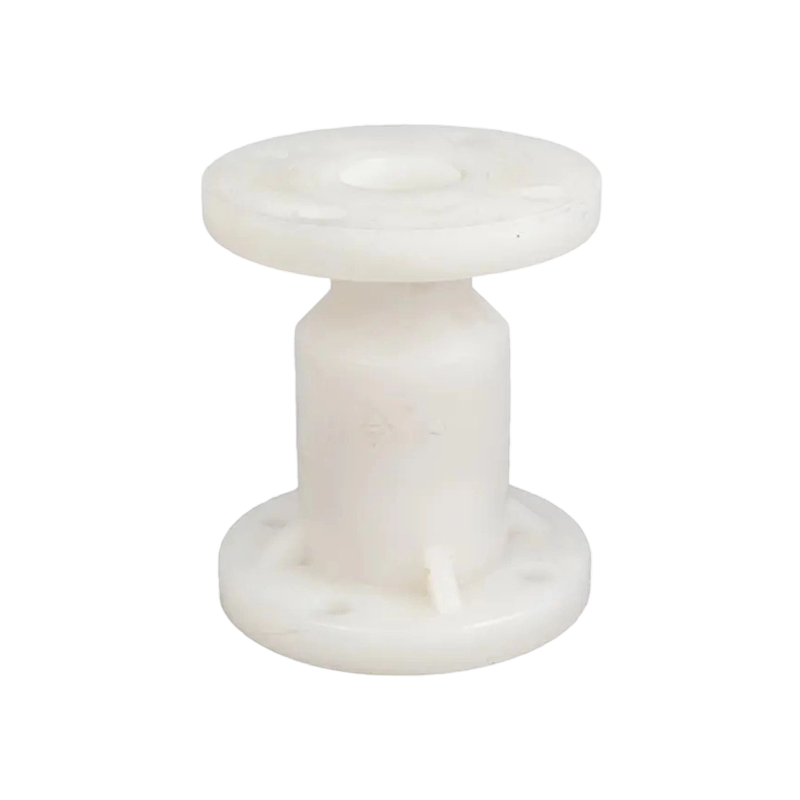
In the product range of a thermoplastic valve manufacturer, these distinctions translate directly into different body patterns and connection styles. Swing check valves are available with flanged or wafer connections and are chosen when the line is clean and horizontal. Ball check valves are offered in flanged and true-union designs, and the union version can be pulled out of the line without disturbing the piping. Lift check valves, while less common in plastic systems, still appear in high-pressure thermoplastic lines where tight shut-off is the priority. The sections below give the operating principle, strengths, limits, and typical applications of each type.
Swing Check Valve
Lowest pressure drop
A hinged disc rotates open with forward flow and falls back by gravity. Best for clean liquids in horizontal or vertical-up lines.
Ball Check Valve
Dirt tolerant
A free-moving ball lifts off the seat and reseats when flow reverses. Handles viscous fluids and light solids. Can be installed close to pumps.
Lift Check Valve
Tight sealing
A guided disc or piston moves straight against the seat. Suited to clean media and higher pressures, with higher pressure drop.
Wafer / Dual-Plate Check
Compact and light
Two spring-loaded half-discs fold open and close between two flanges. Short face-to-face length; low weight; responds quickly.
Swing Check Valve: Low Pressure Drop for Clean, Continuous Flow
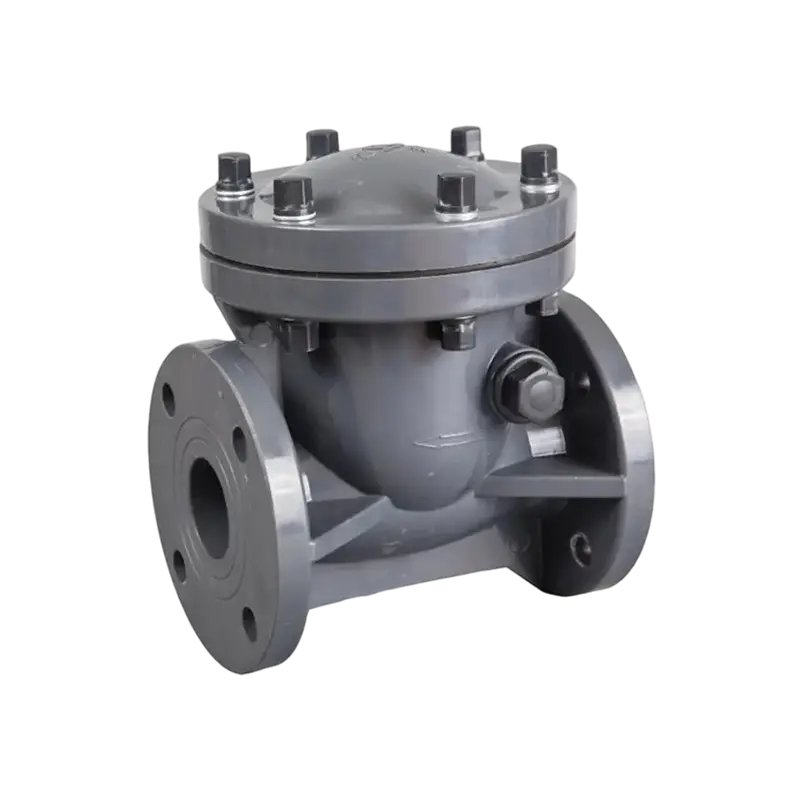
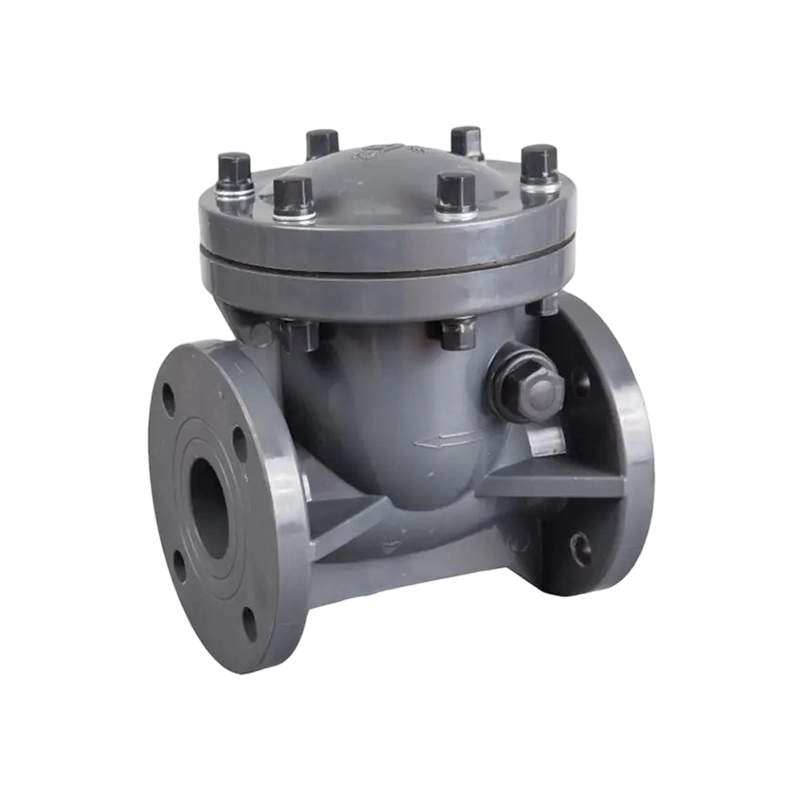
If the fluid is clean, the flow is continuous, and the pipe is horizontal, the swing check valve is usually the first type to evaluate. Inside a swing check valve, the closing element is a disc mounted on a hinge or pin at the upper edge of the flow path. Forward flow pushes the disc open until it swings into the upper chamber of the body. When the flow slows, stops, or attempts to reverse, gravity pulls the disc back onto the seat. Because the disc rotates rather than translates, the open valve leaves an almost straight path for the fluid, which keeps flow resistance low.
That straight flow path is the main reason swing check valves are specified on pump discharge lines, plant water headers, and chemical transfer lines where energy efficiency matters. In thermoplastic valves made of UPVC, CPVC, PPH, or PVDF, the swing design avoids the tortuous passages that encourage erosion and noise at high velocities. The body is typically a two-part construction with a cover, which provides access for seat inspection and disc replacement without removing the valve from the line.
The trade-off is closing speed. A swing disc is heavy relative to the closing force available, and if the flow stops abruptly, the disc can slam onto the seat, creating a pressure spike known as water hammer. The same effect occurs when a pump trips and the fluid column reverses quickly. For this reason, swing check valves are not recommended on short-cycle pump services or on lines where flow reverses suddenly. Where water hammer is a concern, a spring-assisted disc or a faster-closing ball or wafer check valve is a better starting point.
Orientation is another practical limit. A swing check valve must be installed in a horizontal pipe or in a vertical pipe with upward flow. In vertical downward flow, the disc cannot fall back against the seat because gravity holds it open. In horizontal lines, the hinge must be at the top so the disc closes reliably. The minimum operating pressure is also worth checking: at very low flow velocity, a swing disc may hover partially open and flutter against the seat, causing rapid wear of the seat surface. If the line frequently runs at low velocity, consider a ball or lift type instead.
Typical service points for swing check valves include pump discharge in water transfer, chemical dosing skids with clean liquids, compressed air headers, and cooling water circuits. The seat material, usually a synthetic rubber or elastomer bonded inside the plastic body, should be selected after checking the fluid's temperature and chemical compatibility, because the body and the seat face different exposure conditions.
Ball Check Valve: For Viscous Fluids and Pump Discharge Lines
When the fluid is viscous, contains suspended solids, or the pump starts and stops frequently, the ball check valve is the more forgiving design. A ball check valve uses a spherical ball as the closing element. In the open position, forward flow lifts the ball away from the seat and passes around it. When forward flow stops, the ball falls or is pushed back into the seat, where it forms a circular seal around the bore. There is no hinge to jam, no disc to flutter, and no guide that can be blocked by debris. The ball always returns to the lowest point of the body, which is also the position where sealing is best.
This simple mechanism gives the ball check valve several practical advantages in industrial plastic piping. First, it closes faster than a swing check valve when the flow reverses, which reduces the severity of water hammer in many pump applications. Second, it can handle fluids carrying fine solids, because the ball moves out of the way completely and does not rely on a precision hinge. Third, the sealing line is a circle, which makes the valve less sensitive to small amounts of scale or polymer residue forming on the seat.
The main disadvantage is pressure drop. In the open position, the ball occupies part of the flow path, so the fluid has to change direction around it. The flow coefficient is lower than that of a swing check valve, which means a ball check valve will consume more head in a high-velocity line. Oversizing a ball check valve is a common mistake: if the valve is one or two nominal sizes larger than the pipe, the ball may float and vibrate at low flow, causing seat wear. The valve should be selected on flow velocity range, not simply on pipe size.
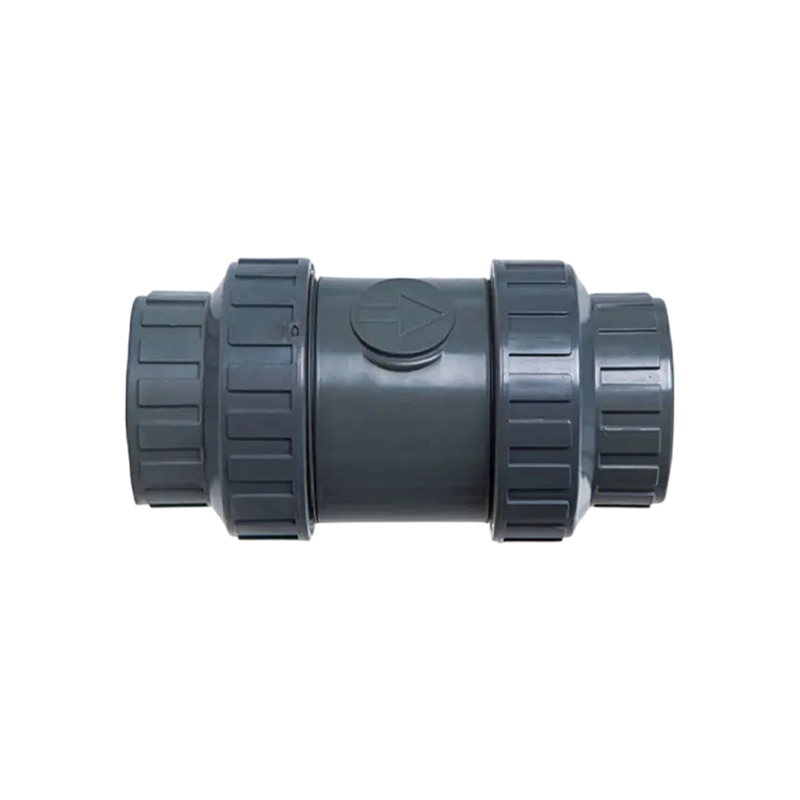
For thermoplastic systems, ball check valves are produced in flanged and true-union body styles. The true-union version is particularly useful in maintenance-sensitive installations because the body can be opened and the ball removed without cutting the pipe or disturbing the flanges. The ball itself is often solid plastic, such as PPH or PVDF, and the seat is an elastomer selected for chemical compatibility. In installations with very aggressive fluids, the ball material should match the pipe material to avoid swelling or surface attack.
Common applications for ball check valves include hydrochloric acid transfer, caustic dosing lines, slurry lines with low solids loading, plating bath circulation, and any pump discharge where a compact, quickly closing check valve is needed. The flanged type is suitable for lines that are dismantled rarely; the union type is ideal for valves that require periodic cleaning.
Lift Check Valve: Tight Sealing Where Pressure Drop Is Acceptable
The lift check valve is the third of the three main types, and it earns its place through sealing quality rather than flow efficiency. Inside a lift check valve, the closing element is a disc or piston that moves straight up and down inside a guide, perpendicular to the seat. Forward flow lifts the disc off the seat; when flow stops or reverses, the disc drops back and seats with a tight fit. The internal body shape is related to the globe valve pattern, and the disc is guided so it returns to exactly the same position every time.
Because the disc is guided, a lift check valve creates a dependable, repeatable seal. This makes it useful for gases, for clean liquids with low viscosity, and for systems that operate at higher pressures where leakage past the closing element would be dangerous or wasteful. The seat can be machined to a higher quality standard than a swing disc seat, because the disc approaches the seat along a fixed axis rather than along an arc.
The trade-off is pressure drop. The fluid must turn as it enters the valve, pass around the disc, and turn again as it exits, which is a significantly more tortuous path than a swing or ball check valve. In long pipelines, the accumulated head loss from a lift check valve can be enough to change the pump duty point. The same geometric constraint also makes lift check valves unsuitable for fluids with suspended solids, which can deposit in the guide and eventually seize the disc.
Orientation depends on the body design. The horizontal pattern has a disc that moves vertically in a plane that is perpendicular to the pipe axis, so it must be mounted with the bonnet upward. The vertical pattern is built for vertical lines with upward flow, where the disc lifts along the pipe axis. Some lift check valves can be converted between horizontal and vertical patterns by changing the seating arrangement, but in plastic valves the body is usually cast for one orientation only.
For thermoplastic piping, lift check valves appear mainly in high-pressure instrument lines, in small-bore chemical injection systems, and in gas or vacuum services where a bubble-tight closure is more important than low head loss. When a compact valve with a quick response is required, a spring-guided silent check valve based on the lift principle is also available; it uses a spring to push the disc closed, which reduces water hammer.
Wafer Check Valve: The Compact Alternative Between Two Flanges
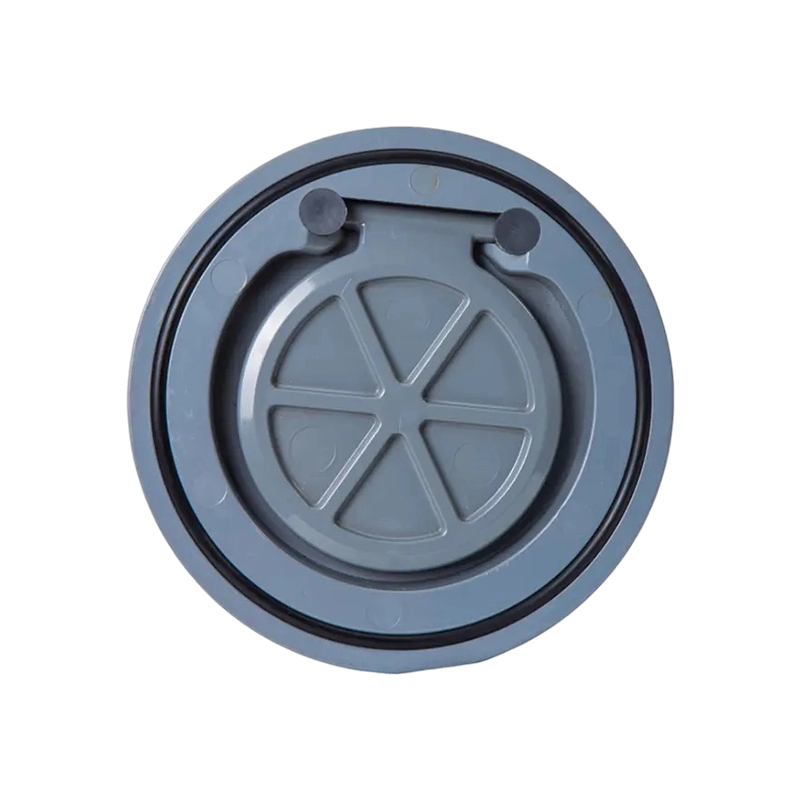
A wafer check valve belongs in this discussion because it is the most common compact alternative to the three main types. It is sometimes called a dual-plate or double-disc check valve. Instead of one large closing member, the wafer check valve uses two semicircular plates, or half-discs, mounted on a central hinge pin that runs vertically through the valve body. With no flow, the plates are held shut by torsion springs. Forward flow folds them open against the springs; when flow reverses, the springs and the reverse pressure snap the plates closed.
The first advantage of a wafer check valve is size and weight. The valve body is essentially a short cylinder that fits between two pipe flanges and is held in place by the flange bolts. Its face-to-face length is much shorter than a swing or ball check valve of the same diameter, and its weight is lower. In large diameters, for example DN200 and above, this produces meaningful savings on support structures and installation labor, especially in vertical lines where heavy valves are difficult to handle.
The second advantage is closing speed. Because the two plates travel a short distance, the wafer check valve responds quickly to reverse flow, which reduces water hammer. The spring force also ensures that the plates begin closing as soon as the forward flow velocity drops, rather than waiting for gravity to act. This makes the wafer design popular on the discharge of pumps that cycle frequently.
The main installation requirement is accurate centering. The valve must sit concentrically between the two flanges so that both plates open evenly and the hinge pin does not rub against the gasket. If the valve is mounted off-center, one plate can jam in the half-open position, or the gasket can be damaged when the flange bolts are tightened. In plastic piping, the wafer body is commonly molded in UPVC, CPVC, PPH, or PVDF, with a corrosion-resistant spring. Nickel-based alloys are often used for the spring and hinge pin in aggressive chemical services.
For corrosive applications, the wafer check valve should be selected with the same care given to the body material, because the spring is the first part to fail if the fluid attacks it. A plastic body with a metal spring is only as corrosion-resistant as the spring. All-plastic spring designs exist for small diameters, but for larger sizes the spring material must be confirmed against the fluid specification.
Foot Valves: A Ball Check Variant That Holds Pump Priming
A foot valve is the practical answer to a very specific problem: keeping a pump suction line full of liquid. When a pump sits above the liquid level in a tank or well, the suction line must stay full so that the pump can prime on the next start. If the liquid drains back when the pump stops, the pump loses prime and runs dry, which destroys mechanical seals and impellers.
A foot valve is fundamentally a ball check valve with an added strainer screen at the inlet. It is installed at the bottom of the vertical suction line, submerged in the liquid. When the pump runs, liquid is drawn upward past the ball, which lifts off the seat. When the pump stops, the liquid column above the valve presses the ball back onto the seat, sealing the line. The strainer keeps larger particles and debris from entering the suction pipe and reaching the pump.
Foot valves are available in flanged and union versions in the same thermoplastic materials as other check valves. The union version simplifies maintenance of the strainer, which is the most frequent service point: the screen gradually plugs with debris in dirty water, and the pressure drop across the valve rises, causing cavitation at the pump. Regular cleaning of the strainer is more important than any other maintenance step.
The seat and ball configuration is essentially identical to a ball check valve, so the material selection logic is the same. The spring, if present, is used only to hold the ball gently in place during low-flow periods; most foot valves operate without springs to avoid restricting the suction flow. When sizing a foot valve, the velocity through the strainer screen should be kept low to avoid excessive pressure drop on the suction side of the pump.
Side-by-Side Comparison of Check Valve Types
The table below compares the three main types and the two most common variants on the factors that determine a practical selection. The same comparison applies to metal and thermoplastic valves, although the pressure and temperature limits differ with the body material.
Comparison of the three main check valve types and the most common variants for industrial piping systems
Type
Closing element
Typical orientation
Pressure drop
Water hammer tendency
Best fluid condition
Main limitation
Swing check
Hinged disc
Horizontal or vertical-up
Low
Medium (disc slam on sudden stop)
Clean, low-viscosity liquids
Poor with dirty media; needs space for disc travel
Ball check
Free-moving ball
Horizontal or vertical-up
Medium
Low to medium
Viscous fluids, light solids
Higher head loss; ball may vibrate at low flow
Lift check
Guided disc or piston
Horizontal (bonnet up) or vertical-up
High
Low if spring-assisted
Clean liquids and gases at higher pressure
High pressure drop; unsuitable for solids
Wafer / dual-plate
Two spring-loaded plates
Any, with flanges on both sides
Low to medium
Low
Clean or mildly dirty liquids
Requires accurate centering between flanges
Foot valve
Ball plus strainer screen
Vertical, submerged at line end
Medium; rises as screen plugs
Low
Suction lines of pumps
Requires periodic strainer cleaning
The chart below illustrates the relative pressure drop of each family at the same flow rate and pipe size. Values are normalised estimates for typical industrial sizes.
Relative Pressure Drop at Equivalent Flow Rate
SwingLow
WaferLow-Med
BallMedium
LiftHigh
Lower is better. Estimates based on typical Cv values for thermoplastic check valves at the same nominal diameter.
For a more detailed look at the operating characteristics of a check valve body and its flow path design, the article on how to choose the best check valve for your fluid explains the effect of flow distribution, seat angle, and disc geometry on real-world performance.
How to Choose Among the Three Main Check Valve Types
The correct selection process starts with the fluid, then the pipe layout, then the acceptable pressure loss, and finally the failure consequences. Working in this order prevents the most common specification error, which is selecting a valve body pattern before considering the service condition.
Identify the fluid. Clean water, air, and clarified chemical solutions suit all three main types, but swing and lift types need clean media. Viscous fluids, slurries, or fluids that deposit scale point toward a ball check valve or a wafer check valve.
Define the pipe orientation. Horizontal lines accept all types. Vertical lines with upward flow accept swing, ball, lift, and wafer types. Vertical lines with downward flow need a wafer check valve or a spring-loaded check valve, because gravity cannot close a swing or ball element in downward flow.
Calculate the acceptable pressure drop. If the pump has spare head and the line is short, a lift check valve is tolerable. If the line is long or the pump is already near its curve, choose a swing or wafer type with a low pressure drop.
Check how quickly flow stops. Pumps that trip or cycle quickly produce reverse flow within milliseconds. For this duty, a ball check valve, wafer check valve, or spring-loaded lift check valve closes fast enough to limit water hammer. A heavy swing disc will slam.
Check the connection and maintenance plan. If the valve must be removed frequently, choose a true-union ball check valve or a flanged type with easy cover access. If the valve is buried or inaccessible, a wafer check valve between flanges is simple to replace but requires careful alignment.
Confirm temperature and chemical compatibility of the body, seat, ball, and spring. The valve type is irrelevant if the elastomer seat swells or the spring corrodes in service.
When the selection is still uncertain, the best approach is to compare the failure mode of each candidate. If a swing check valve is chosen for a pulsating flow, seat wear will be the likely failure. If a lift check valve is installed on a line with fine particles, the disc guide will jam. If a wafer check valve is mounted off-center, the plate will prevent full closure. Choosing the opposite type in each case usually avoids the failure.
Typical Pressure Drop Trend with Increasing Flow Velocity
The curves show that pressure drop grows with flow velocity for all types, but the lift check valve consumes the most head and the swing check valve the least at the same velocity.
Material Selection: Thermoplastic Check Valves and Their Practical Limits
Choosing among the three main types is half of the specification. The other half is the body and seat material. A swing check valve designed for clean water will not survive a hot acid line if the body is the wrong polymer, and a ball check valve with a natural rubber seat will swell quickly in hydrocarbons. In industrial plastic piping systems, the valve material must be matched to the fluid, the temperature, and the pressure rating in exactly the same way as the pipe itself.
Thermoplastic check valves are manufactured in the same resin families as the piping systems they serve. Each material has a temperature ceiling and a chemical compatibility profile, and the valve seat adds a further restriction because elastomers soften, swell, or harden depending on the fluid.
UPVC valves are the economical workhorse. They handle water, many acids, alkalis, and salt solutions at temperatures up to roughly 60 degrees Celsius. UPVC is not suitable for aromatic hydrocarbons or hot oxidizing acids.
CPVC valves extend the temperature range to roughly 90 degrees Celsius and are used for hot corrosive liquids in plating and chemical processing. CPVC has better impact resistance at elevated temperature than UPVC.
PPH valves, made from polypropylene homopolymer, provide excellent resistance to acids, alkalis, and organic solvents, with a temperature limit of about 80 degrees Celsius. PPH is lightweight and weldable, which simplifies repair.
PVDF valves are the top-tier option for aggressive chemicals, with a temperature ceiling of about 140 degrees Celsius and very low permeation. The semiconductor and pharmaceutical industries use PVDF for high-purity and high-temperature services.
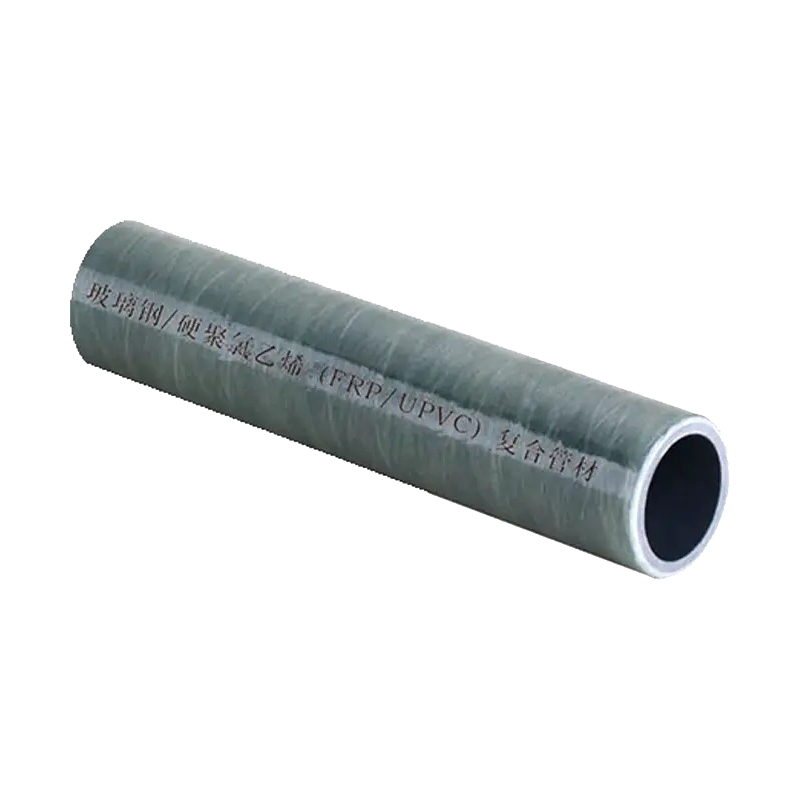
FRPP and FRP composite valves add glass-fiber reinforcement for higher mechanical strength in large diameters and high-pressure lines.
The seat material deserves as much attention as the body. Most thermoplastic check valves use an elastomer seat, such as EPDM, FPM (FKM), or PTFE-lined designs. EPDM resists hot water, steam, alkalis, and many acids. FPM resists oils, fuels, and aggressive chemicals at higher temperatures. PTFE linings provide nearly universal chemical resistance but have some cold-flow behavior under prolonged compression. In a ball check valve, the ball material matters as well: a solid PVDF ball in a UPVC body should not be expected to perform exactly like a solid PPH ball, because density and surface hardness affect both sealing and wear.
For a manufacturer that supplies complete thermoplastic piping systems, the advantage of matching the check valve to the pipe material is cost predictability and a single source of responsibility. If the pipe is CPVC, specifying a CPVC check valve with a compatible elastomer seat avoids the galvanic and thermal-expansion mismatches that can appear when a metal check valve is fitted into a plastic line. Metal check valves are still used on plastic piping in some plants, but the threaded or flanged connection, the weight, and the corrosion difference between body and pipe create long-term maintenance issues.
Common Installation Mistakes That Cause Check Valves to Fail
A check valve that fails shortly after installation is often not a manufacturing fault. It is more frequently a product of incorrect orientation, improper sizing, or poor pipe preparation. The three main types each have specific installation rules, and the most common field failures trace back to one of the following mistakes.
Installing a swing check valve in vertical downward flow. The disc hangs open on gravity and the valve provides almost no reverse-flow protection.
Mounting a ball check valve without checking the flow direction arrow. A reversed ball check valve blocks the line completely as soon as the pump starts.
Installing any check valve where the flow velocity is too low. The ball or disc hovers near the seat and chatters, wearing the elastomer seat in weeks.
Fitting a wafer check valve off-center between flanges. Uneven plate opening and gasket damage are the typical results.
Choosing a lift check valve for a line with suspended particles. Solids accumulate in the disc guide and seize the valve in its open or closed position.
Oversizing a check valve to reduce pressure drop. Larger valves have lower flow velocity, which means the ball or disc bounces on the seat and never reaches a stable open position.
Forgetting a strainer on a new PVC or CPVC line. Solvent cement, pipe shavings, or Teflon tape debris from installation travels to the check valve and prevents full closing, causing weeping reverse flow.
In thermoplastic systems there is an additional installation rule: the solvent-cement and welding operations should be completed before the check valve is fitted, not after. Solvent cement fumes can attack elastomer seats, and heat from fusion welding can deform the seat of an adjacent valve. The check valve should be the last component installed in a new section of piping, and it should be handled by the plastic body rather than by the flanges to avoid bending loads that distort the seal face.
Industry Applications: Which Check Valve Type Goes Where
Every industry develops a preference for one or two check valve types, and the preference is based on fluid conditions, not habit. The following summary matches typical services with a recommended valve family and the reasoning behind it.
Chemical processing
Ball and swing checks dominate. Ball checks suit viscous reagents and slurries; swing checks handle clean acids and solvents with minimal head loss.
Water treatment
Swing checks on clean water lines, ball checks on polymer dosing and sludge lines. Wafer checks are used in skids where space is limited.
Plating and metal finishing
Ball check valves are preferred because plating baths contain suspended hydroxide solids. CPVC bodies handle hot chrome and nickel solutions.
Pharmaceutical and biotech
PVDF ball and diaphragm-style check valves give clean, crevice-free surfaces. Union connections allow periodic disassembly for cleaning.
Semiconductor and electronics
PVDF wafer and ball checks in high-purity acid lines. The low permeation of PVDF protects ultrapure chemical distribution systems.
Agriculture and irrigation
Foot valves hold priming on centrifugal pump suctions. Ball checks protect fertilizer injection points from backflow into the dose tank.
In every industry, the valve type is only the first layer. The seat elastomer, the connection style, and the pressure rating complete the specification. A plating line that runs at 75 degrees Celsius in CPVC pipe should use a CPVC ball check valve with an FKM or EPDM seat, not a UPVC valve with a nitrile seat, regardless of which of the three main types is chosen.
Frequently Asked Questions About the Three Main Types of Check Valves
What are the three main types of check valves?
The three main types are swing check valves, ball check valves, and lift check valves. They are classified by their closing element. A swing check valve uses a hinged disc, a ball check valve uses a free-moving spherical ball, and a lift check valve uses a guided disc or piston that moves straight against the seat. Wafer check valves and foot valves are common variants of these families rather than entirely separate categories.
Which of the three main check valve types has the lowest pressure drop?
The swing check valve has the lowest pressure drop because its disc rotates fully out of the flow path, leaving an almost straight passage. In a thermoplastic valve, the swing design is therefore preferred on pump discharge and long transfer lines where head loss converts directly into energy cost. The lift check valve creates the highest pressure drop of the three types, and the ball check valve sits between them.
Can a ball check valve be installed vertically?
A ball check valve can be installed in a vertical line with upward flow. In this position, gravity helps the ball return to the seat when the pump stops. A ball check valve should not be used in a vertical line with downward flow because the ball can be held away from the seat by the downward stream. A foot valve, which is a ball check valve with a strainer, is designed specifically for the bottom of a vertical suction line.
Why does a swing check valve cause water hammer?
A swing disc is heavy and travels along a long arc. When forward flow stops suddenly, the fluid column reverses and slams the disc onto the seat at high speed. The contact creates a pressure spike that travels through the pipe. Solutions include selecting a wafer or ball check valve that closes faster, adding a spring to assist the swing disc, or slowing the flow velocity. In thermoplastic piping, water hammer is especially damaging because plastic flanges and solvent-cemented joints are less resilient than welded steel.
What is the difference between a check valve and a backflow preventer?
A check valve is a single automatic valve that stops reverse flow in one direction. A backflow preventer is an assembly containing two check valves and a test port in one unit, used where cross-connection of potable water and contaminated process fluid must be physically separated. Backflow preventers are required by water regulations; a check valve alone is usually not accepted as a substitute for a backflow preventer on drinking water connections. The two terms are often confused in plant maintenance.
Are plastic check valves as reliable as metal check valves?
For corrosive fluids, a thermoplastic check valve is often more reliable than a metal one because the body cannot rust or scale. The working parts, however, are different: the plastic ball or disc is lighter, and the seat is elastomeric, so temperature and chemical compatibility must be respected. If the valve is correctly matched to the fluid temperature, plastic check valves provide long service life at a lower weight and cost. The most common premature failures result from choosing an elastomer seat that is incompatible with the fluid or from water hammer that exceeds the pressure rating of the plastic body.
How do I decide between flanged and true-union connections for a check valve?
A flanged connection is the stronger and more rigid option, suitable for large diameters and high bending loads. A true-union connection allows the valve to be opened or removed from the line by loosening the union nuts, without disassembling the adjacent pipe sockets. For ball check valves in plastic piping, the true-union style is the best maintenance choice because the ball and seat can be inspected in place. Flanged connections are preferred for wafer check valves because the wafer body itself is sandwiched between two flanges.
Final Recommendation: Start with the Classification, Then Verify the Details
The shortest route to a reliable check valve specification is to name the family first. If the fluid is clean and the line horizontal with stable flow, specify a swing check valve. If the fluid is viscous, carries particles, or the pump starts and stops often, specify a ball check valve. If the service is high-pressure, clean, and demands a tight seal, specify a lift check valve. If installation space is tight or the valve must work in any orientation, use a wafer check valve. And if the valve sits at the bottom of a pump suction line, use a foot valve.
After the family is selected, verify the four details that determine whether the valve will survive its first year of service: the body material against the fluid and temperature, the seat elastomer against chemical attack, the pressure rating against the maximum surge pressure including water hammer, and the connection type against the maintenance plan. In thermoplastic systems, these four details account for nearly every premature check valve failure observed in the field.
For engineers who manage plants with aggressive chemical fluids, a thermoplastic check valve from a manufacturer with its own valve and piping range offers an advantage: the valve, the pipe, and the fittings come from the same material system, so thermal expansion, chemical resistance, and pressure ratings are consistent across the complete line. The three main types of check valves all exist within that system, and the correct choice is the one whose mechanism matches the fluid and the flow profile, not the one that looks most familiar.