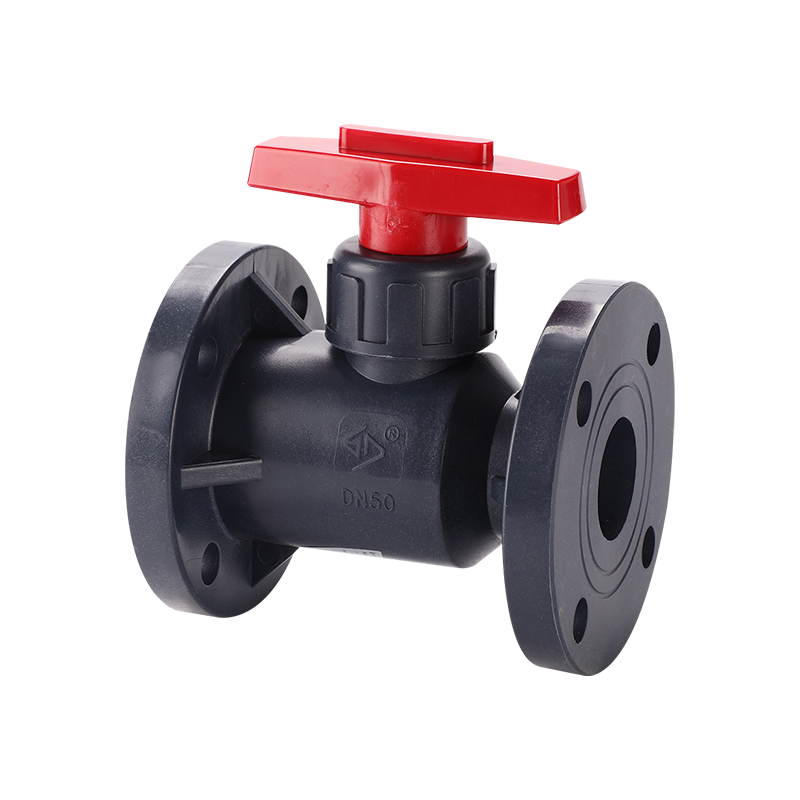
A 2-inch true union PVC ball valve on a waste acid line starts dripping around the handle at 9:30 in the morning, and by 11:00 the stem seal fails completely. A 3/4-inch threaded ball valve on a compressor cooling line cracks apart when a maintenance assistant uses a pipe wrench to close it one last time. A flanged PVC ball valve in an outdoor installation becomes brittle after three summers and snaps at the neck when a technician opens it after a long shutdown. These scenarios are typical industrial service records. They illustrate the most common PVC ball valve problem families: stem seal leaks, over-torque body cracking, and UV embrittlement. Each family has a distinct root cause, a set of early signs, and practical prevention methods that a plant team can implement without redesigning the entire line.
~65%
of premature failures relate to installation torque, pipe misalignment, and insufficient support
~20%
trace to chemical incompatibility or running the valve above its rated temperature range
~10%
come from seal wear, ball surface erosion, and operator practice such as throttling
~5%
stem from material defects, mold marks, or weld line weaknesses that factory inspection should catch
What Actually Fails on a PVC Ball Valve
A PVC ball valve has five functional zones that can fail independently: the ball, the PTFE or RPTFE seats, the stem seal area, the body joint between the end caps, and the connection ends that go into the piping system. When a maintenance report says the valve is bad, it rarely means the entire valve. It usually means one zone has reached its limit, and the other zones are still sound. This is why the replacement decision should never be automatic. Knowing which zone failed helps you decide whether to repair the valve, replace it with the same design, or upgrade to a different body style.
Field service feedback from chemical plants, plating shops, and water treatment facilities shows that no single failure mode dominates every site. The distribution depends heavily on how the valve is installed and operated. The chart below gives a rough picture of what industrial maintenance records show when all installation conditions are averaged.
Joint or connection leaks
Overview of common PVC ball valve failure modes, visible symptoms, and prevention focus
| Failure mode |
First visible sign |
Primary root cause |
Prevention focus |
| Stem seal leak |
Moisture film or drip under the handle |
O-ring wear, sand, over-torque, handle rocking |
Use the handle only, keep the stem area clean, replace O-rings periodically |
| Body crack at the joint |
Hairline crease near the end cap or wrench flats |
Over-tightening, pipe stress, water hammer, freezing |
Use strap wrenches, support the pipe, protect from freeze |
| Connection leak |
Leak at threaded or solvent cemented point |
Wrong cement, loose thread, misalignment, missing sealant |
Clean and prime the joint, use proper thread sealant, align before tightening |
| Internal leak |
Flow continues in the closed position |
Scored ball, deformed seat, debris trapped in the seat area |
Flush the line before commissioning, keep throttling to a minimum |
| Handle breakage |
Crack in the handle or stripped stem flats |
Excessive force, UV-embrittled handle, impact damage |
Apply calm force, replace handles after outdoor aging |
| Ball surface erosion |
Flow drops, valve becomes hard to turn |
Abrasive solids in the medium, cavitation, frequent throttling |
Install a strainer, select a larger valve to reduce velocity |
Stem and Handle Failures: Why the Top End Gives Trouble First
The stem seal area is a logical weak point on every plastic ball valve. The valve body is rigid, but the stem has to pass through the body and be sealed with O-rings while allowing rotation. That rotating interface is exposed to pipe pressure, temperature changes, and physical contamination. The most common stem problem is not a dramatic crack but a slow leak that appears after months of normal operation. The O-ring material hardens or gets scratched by dried medium particles, and the seal stops following the stem surface.
Handle problems are usually made worse by leverage. A technician who finds a valve difficult to turn may use a wrench or a piece of pipe as an extension. That multiplies the input torque and transmits bending movement to the stem. Over time the stem flats round off, the handle starts to slip, and the O-ring groove wears unevenly. The practical rule for a manually operated PVC ball valve is to use only the factory handle, and to turn it with steady hand force without sudden jerks. If the valve will not turn easily with a normal grip, the internal seat or the ball surface already has a problem that no extra leverage can fix.
Stem and handle problem patterns and their correct responses
| Observed condition |
Likely cause |
Correct action |
| Small drip around the stem nut after 6 months |
O-ring wear or contamination |
Disassemble the stem area, clean the groove, install a new O-ring set |
| Handle slips and will not close the ball |
Stem flats stripped by repeated over-torque |
Replace the stem if possible; otherwise the valve must be replaced |
| Handle cracks in the grip area |
UV aging or brittle material |
Replace the handle with a new one and add UV protection in outdoor service |
| Stem turns but the ball does not move |
Broken stem connection or seized ball |
Remove the valve and inspect; do not force the handle further |
| Valve becomes harder to turn over time |
Seat compression set, debris, or scale on the ball |
Flush the line and cycle the valve fully open and closed several times |
In high-cycle applications such as batch processing where the valve opens and closes more than 20 times per day, stem seal maintenance becomes a planned activity rather than an emergency repair. A plastic ball valve with a true union body design makes this service much simpler because the valve can be removed from the line without disturbing the pipe connections.
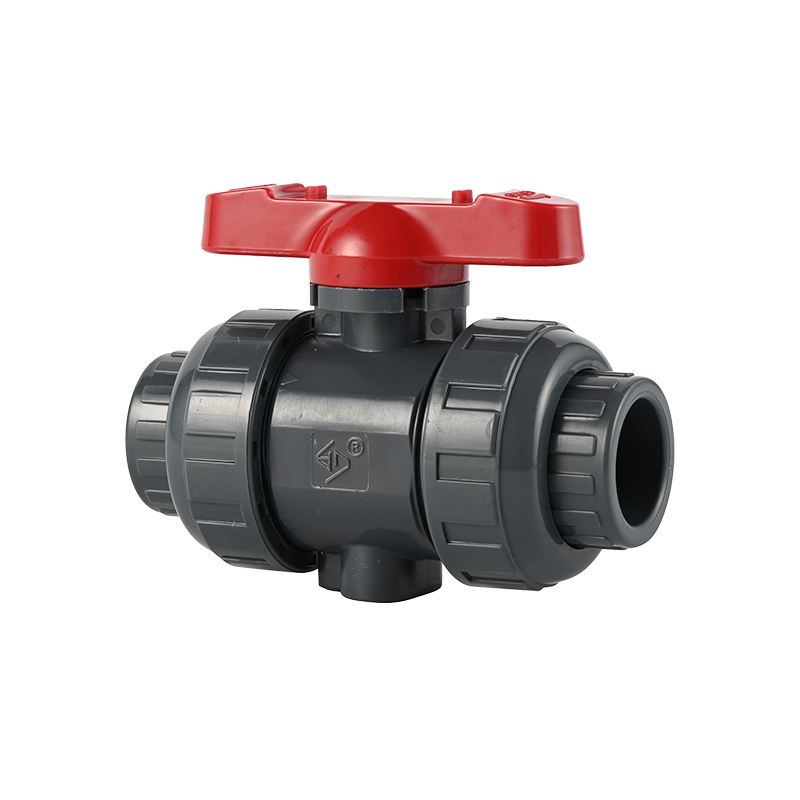
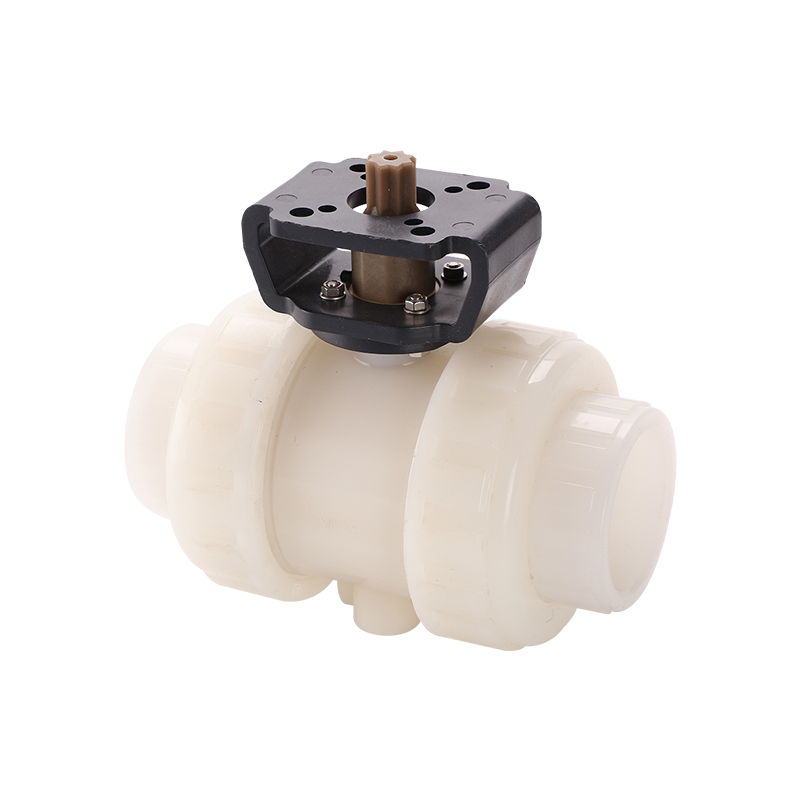
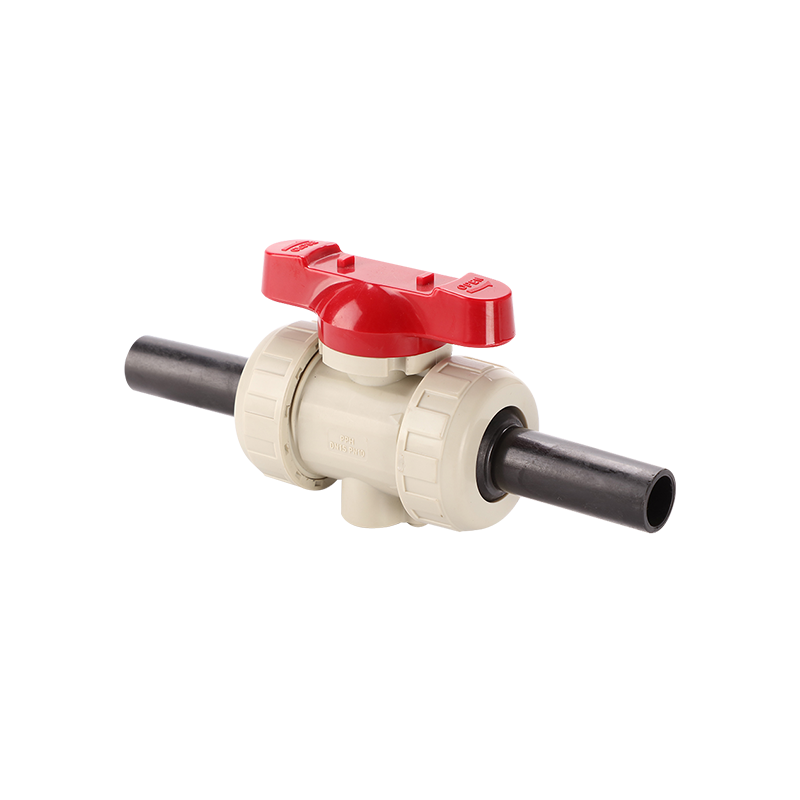 True Union Ball Valve for Easier Maintenance and Reliable SealingThis full-bore valve simplifies stem seal service without disturbing pipe connections, while its thicker spool and PTFE seals address leak concerns at threaded joints.View Product →
Joint and Union Leaks: Where Installation Quality Shows Up
Leaks at the connection point are the second largest group of PVC ball valve complaints. These leaks are almost never caused by a failure inside the valve. They happen because the joint was made incorrectly or because the piping system is putting stress on the connection. A threaded PVC joint needs a clean thread, proper sealant, and controlled tightening torque. When a technician tightens a threaded male adapter too far, the socket can split under the stress of the thread engagement. The crack might not be visible at first, but it opens up after a few heating and cooling cycles.
Solvent welded joints create a different set of problems. Using regular PVC cement on CPVC pipe, applying cement to wet or dirty surfaces, or not allowing enough cure time before pressurizing the line are common causes of joint leaks. The joint looks solid from the outside but the solvent bond is incomplete, and a slow weep develops under pressure. Experienced installers pre-fit every PVC joint dry, mark the insertion depth, and let the solvent cure for at least 24 hours before the line goes back into service.
Union connections are a convenient feature on true union ball valves, but they introduce one more sealing surface. The union O-ring requires uniform compression from the union nut. If the pipe is misaligned and pulls to one side, the union nut will be tightened unevenly, and the O-ring will deform. A related problem is over-tightening the union nut, which compresses the O-ring so much that it loses its elastic memory and starts leaking after the first thermal cycle. The solution is to align the pipe runs before tightening the union, and to tighten the union nut only until it seats firmly with hand force plus a slight extra turn.
For teams that specify and install these valves, the step-by-step installation instructions cover the most common fitting methods and the mistakes to avoid at each step.
Internal Leaks: Seat and Ball Surface Damage
An internal leak appears when the ball is in the closed position but medium still flows past the seat. The flanged or threaded connection is dry, the stem area is dry, yet the line downstream continues to receive fluid. This failure mode is often not noticed until a pump fails to prime or a tank level rises unexpectedly. Internal leakage is caused by the loss of a tight seal between the polished ball surface and the PTFE seat ring.
PTFE seats have excellent chemical resistance and a low friction coefficient, but they can deform permanently when exposed to high seat pressure over a long period. This is called compression set or cold flow. Once the seat has taken a permanent shape that no longer matches the ball geometry, the valve cannot seal fully. The same problem appears when the valve is operated partially open for long periods. The seat is only pressed against one part of the ball surface, and that area becomes compressed while the rest of the seat stays in its original shape. The next time the valve closes, the uneven seat surface allows a bypass flow.
Abrasive particles in the medium are the other main reason for internal leaks. Fine sand, crystallization from a chemical reaction, or welding debris left in the pipe after installation can score the ball surface and grind tracks into the seat. A single event with contaminated piping can destroy the sealing ability of a PVC ball valve faster than years of ordinary service. Flushing the line before mounting the valve is cheap insurance.
When an internal leak has been confirmed, the valve does not always need to be thrown away. On a true union same body size valve, the seat rings and ball can be accessed after unscrewing the union nut and pulling the center section out. This is also the moment to inspect the ball surface for scratches and replace the PTFE seats with factory parts. The True Union Ball Valve for Easier Maintenance and Reliable SealingThis full-bore valve simplifies stem seal service without disturbing pipe connections, while its thicker spool and PTFE seals address leak concerns at threaded joints.View Product → is designed with serviceability in mind, and many plant engineers choose it specifically because they know the seal system will need periodic attention in aggressive media.
Body Cracks: The Most Dangerous PVC Ball Valve Failure
A cracked body is the failure mode that gets everyone's attention because it usually causes a visible spill and an immediate line shutdown. The crack typically starts at a stress concentration point: the base of the handle neck, the corner of the wrench flats, or the edge of the threaded socket. Once a crack starts, it travels quickly through the PVC wall, and the valve can break into two pieces if the line is under pressure.
The most frequent trigger is over-tightening during installation. A PVC valve body should be tightened by hand, then snugged with a proper size wrench placed on the wrench flats, not on the body or the pipe. Using a pipe wrench on the valve body is a reliable way to create microscopic stress cracks that not appear until weeks later. Another trigger is water hammer. When a ball valve is closed quickly, and the line carries water at a velocity of 2.4 m/s or higher, the pressure spike can reach more than double the working pressure. A PVC valve that was fine at 100 psi static can see a transient of 250 psi and fail at the body joint.
Pipe support is equally important. A ball valve is heavier than the same length of PVC pipe, and if it hangs unsupported in the middle of a span, it acts like a lever arm that bends the end caps. The bending stress concentrates at the socket joints. Long horizontal runs of PVC pipe also expand and contract with temperature changes. Without expansion loops or sliding supports, the thermal movement is transferred to the valve body and the socket connections.
Approximate pressure rating derating for a PVC valve with rising temperature
| Temperature |
Pressure rating factor |
Practical guidance |
| 20°C (68°F) |
100 percent |
Full rated working pressure allowed |
| 30°C (86°F) |
80 percent |
Still suitable for most chemical lines |
| 40°C (104°F) |
63 percent |
Check that the peak system pressure stays below this limit |
| 50°C (122°F) |
50 percent |
Accept only for low pressure or gravity lines |
| 60°C (140°F) |
40 percent |
Approaching the upper service limit; CPVC or PPH is a better choice |
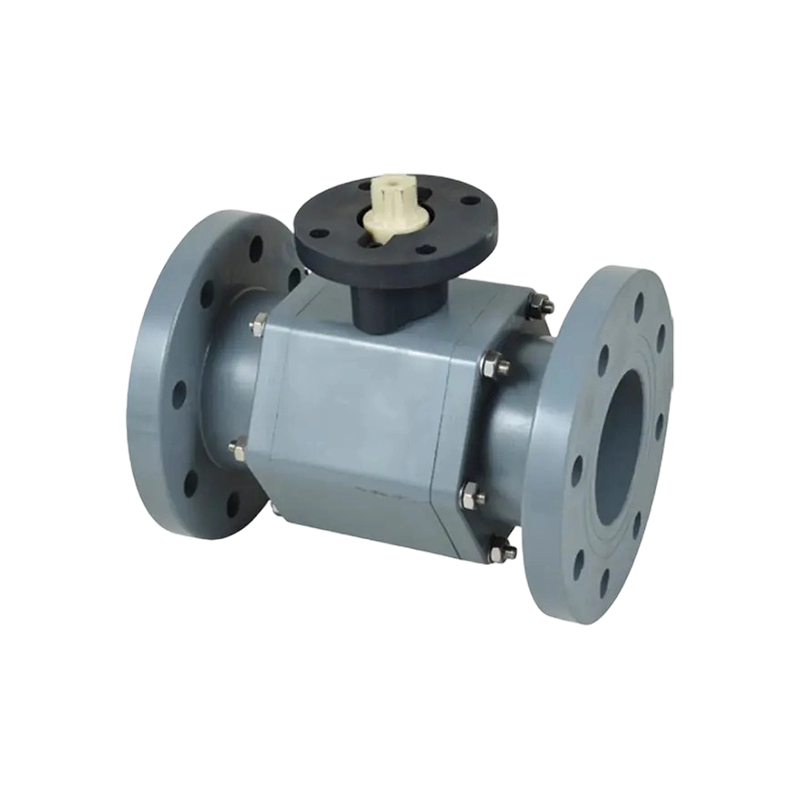
For applications where the process temperature regularly sits near the upper limit or where pressure spikes are difficult to control, a flanged ball valve provides a more robust connection than a threaded or solvent welded body. The flange bolts spread the clamping load evenly, and the full face gasket gives a larger sealing area. Plant engineers who have seen repeated body cracks at threaded connections often move to flanged designs for lines above 2 inches.
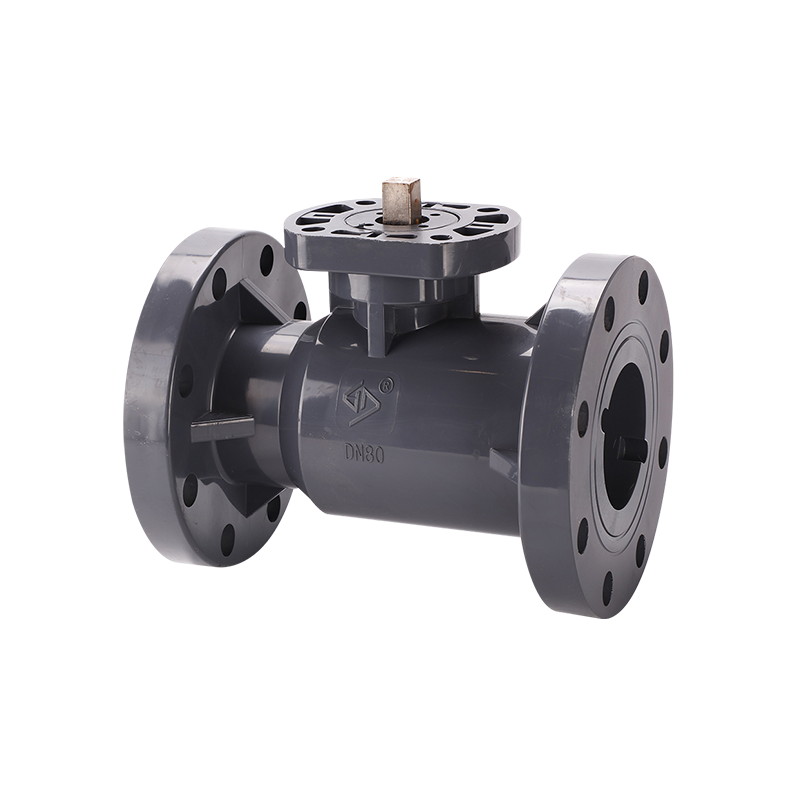
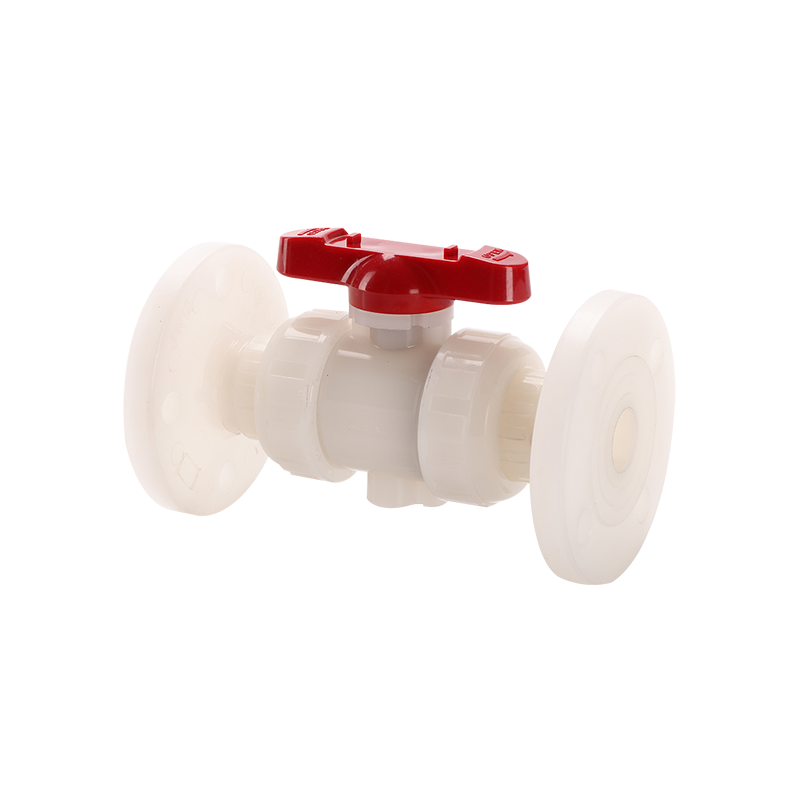 Flanged Ball Valve for Demanding High-Temperature and Pressure LinesA one-piece flanged design spreads clamping load evenly and minimizes leak points, making it a robust upgrade for pipes over 2 inches under stress.View Product →
Chemical Compatibility Mistakes That Cause Premature Collapse
PVC is a versatile material, but it is not a universal answer for every chemical medium. Concentrated sulfuric acid, aromatic hydrocarbons, ketones, and many organic solvents attack the PVC polymer structure. The valve body may soften, swell, or develop environmental stress cracking. A common field observation is a ball valve that looks fine on the outside but has a faint white haze or small cracks around the seat area. That is usually a sign that the medium has migrated into the polymer and weakened it over time.
Material selection needs to account for concentration, temperature, and exposure time. A medium that is perfectly safe at 20°C may become aggressive at 40°C. For chlorinated chemicals, high-temperature acids, and ultrapure applications, CPVC or PPH ball valves are better choices, while PVDF is the material of choice for the most aggressive chemicals. A simplified comparison for common industrial chemicals is shown below.
Chemical resistance comparison for common plastic ball valve materials at room temperature
| Chemical medium |
PVC (uPVC) |
CPVC |
PPH |
PVDF |
| Hydrochloric acid 10 percent |
Excellent |
Excellent |
Excellent |
Excellent |
| Sulfuric acid 50 percent |
Excellent |
Excellent |
Good |
Excellent |
| Sulfuric acid 98 percent |
Not suitable |
Not suitable |
Not suitable |
Limited above 60°C |
| Caustic soda 50 percent |
Excellent |
Excellent |
Good |
Excellent |
| Acetone |
Not suitable |
Not suitable |
Not suitable |
Excellent |
| Sodium hypochlorite 12 percent |
Good |
Good |
Limited |
Excellent |
| Ethylene glycol |
Excellent |
Excellent |
Excellent |
Excellent |
The values in the table are general guidance only. The exact compatibility depends on the concentration, temperature, and duration of exposure. When a plant team is unsure about a chemical, the safe move is to request a compatibility chart from the valve manufacturer or run a short immersion test on a sample piece of the same material before committing to a full installation.
UV Degradation and Outdoor Weathering
PVC ball valves installed outdoors face a slow but continuous degradation process. Ultraviolet light from the sun attacks the polymer chain and causes the surface to become chalky and brittle. At the beginning, the only visible sign is a slight change in color or a rougher surface texture. After one to three years of direct sunlight exposure, the valve body can lose a significant portion of its impact strength. A technician who hits the handle with a tool, or even a sudden gust of wind that swings the handle hard, can cause the neck of the valve to break.
Indoor service does not protect a valve completely if the facility has strong artificial UV light, but the risk is far lower. For outdoor installations, painting the valve body with an acrylic latex paint provides a simple UV barrier. Painting must be done on a clean, dry surface, and the manufacturer should be consulted because some paints can affect the plastic material compatibility. Another approach is to mount the valve inside a weather protection enclosure or provide a simple metal or plastic shield above it.
Temperature extremes also contribute to outdoor failure. A valve body that has been embrittled by UV aging is less able to accommodate the expansion and contraction of the connected PVC pipe. On a sunny day, a dark colored handle can heat up well above the air temperature, accelerating the aging process around the stem area. Light-colored valve bodies and handles help reduce thermal load in hot climates.
Operating Practice: Throttling, Handle Extensions, and Debris
A ball valve is designed for isolation, not flow regulation. Using it to throttle the flow means the ball is held close to the seat at an intermediate position. The high velocity of the medium around the partially open ball erodes the seat and the ball surface, and also increases turbulence and vibration. The valve begins to leak internally much sooner than it would if it were only fully opened or fully closed. When a system needs variable flow control, a diaphragm valve or a butterfly valve with a calibrated positioner is the correct component, not a ball valve.
Handle extensions are another practice that shortens valve life. A long extension on the handle multiplies torque proportionally to its length. A valve that is slightly stiff, requiring 15 Nm of torque at the handle, receives 30 Nm or more when a 2-foot extension pipe is added. This can break the stem, crack the body, or permanently deform the seat. If a ball valve is difficult to operate, the root cause needs to be solved rather than giving the handle more leverage.
Debris in the pipeline is commonly overlooked because it cannot be seen after installation. Particles from cutting and threading pipe, residue from solvent cement, scale from old steel lines, and crystallization products in chemical media all find their way into the valve body. Once inside, the particles settle around the ball and the seat. When the valve is closed, the particles act like a wedge preventing full seating. When a suspected internal leak is investigated, the first step should be to fully open and fully close the valve several times with the line at zero pressure. This flushing action frees many trapped particles and may restore sealing without any disassembly.
Diagnosing a Failing PVC Ball Valve
Diagnosis is faster when the symptom, the likely cause, and the first action are considered together. The cards below summarize practical diagnostics for the most frequent complaints.
Handle area is wet
Stem O-ring worn or scratched
Isolate the line, remove the handle, inspect the stem and O-ring. Replace seals and reinsert with a light silicone lubricant.
Valve body has a hairline crack
Over-torque, pipe stress, or pressure spike
Replace the valve. Check the pipe supports and confirm that line pressure never exceeds the rating. Do not attempt to patch the crack.
Fluid leaks at the threaded joint
Incomplete thread sealant or cracked socket
Remove the valve, clean the threads, apply fresh sealant, and tighten to the specified range using a strap wrench on the body.
Flow continues after closing
Seat deformation, particle wedging, or ball scoring
Cycle the valve fully several times with no pressure to dislodge particles. If the flow continues, open the body and inspect the seat and ball surface.
Handle is stiff and difficult to rotate
Seat compression set, ball surface damage, or handle/stem wear
Do not force. Isolate, disassemble, inspect the ball and seats. If the ball is scored, replace the valve or the internal parts.
Valve snapped when the handle was bumped
UV brittleness of an aged PVC body
Replace with a new valve and apply UV protection. For outdoor service, select a valve with a UV stabilized compound.
Prevention and Maintenance That Lower the Failure Rate
A PVC ball valve that is correctly selected and installed should provide several years of service in a chemically compatible medium. Regular maintenance is minimal, but it cannot be skipped. A practical schedule for industrial installations includes a visual inspection every three months in continuous service and a functional check every six months in standby service.
The inspection routine covers five points. First, look for leakage around the stem, handle, and connection ends. Second, confirm that the pipe supports are not allowing the valve to sag. Third, exercise the valve from fully open to fully closed and check that the handle travels smoothly and reaches both stops. Fourth, feel the surface temperature of the body with a hand or an infrared thermometer and compare it with the rated limit. Fifth, check the color and surface texture of the valve body for chalking or discoloration, which signals UV aging or chemical attack.
When the valve is exercised, the O-ring and seating surfaces benefit from a regular full open and full close cycle. This redistributes the lubricant, removes thin deposits, and prevents the seat from sticking to the ball after a long idle period. For valves that remain in one position for more than one year, such as a fire protection line that is normally open, the functional check is especially important.
Daily maintenance of plastic valves is covered in more detail in the plastic valve maintenance guide, which gives specific inspection and testing procedures for different service conditions. For production lines where downtime is expensive, keeping a set of replacement seat rings, O-rings, and handles for common valve sizes can shorten repair time. A three-piece ball valve body construction allows the center section to swing out for inspection and seal replacement without removing the end connectors from the pipe, making it an economical option for lines where repair speed matters.
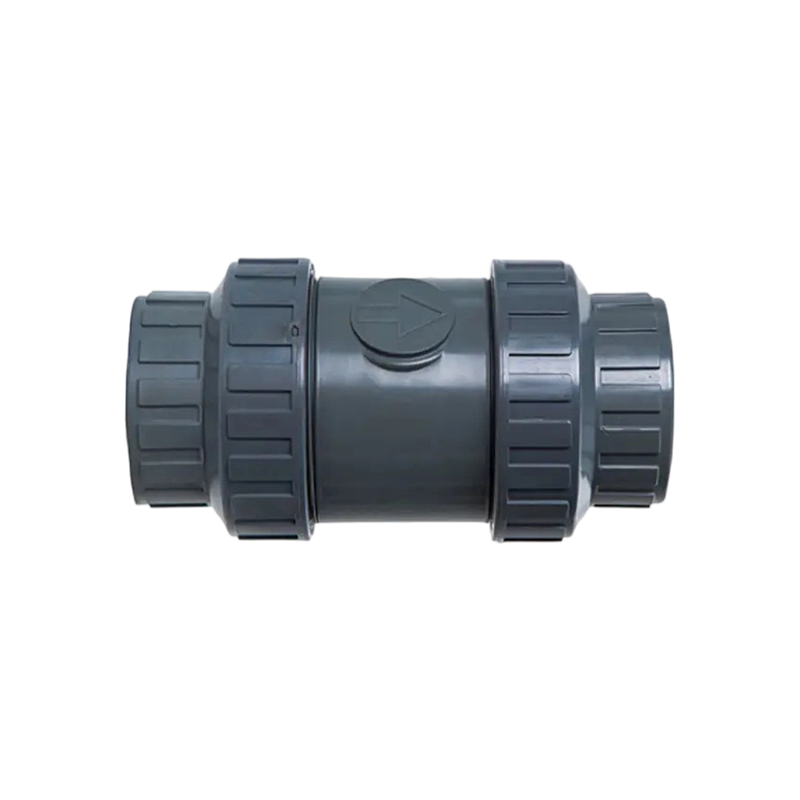
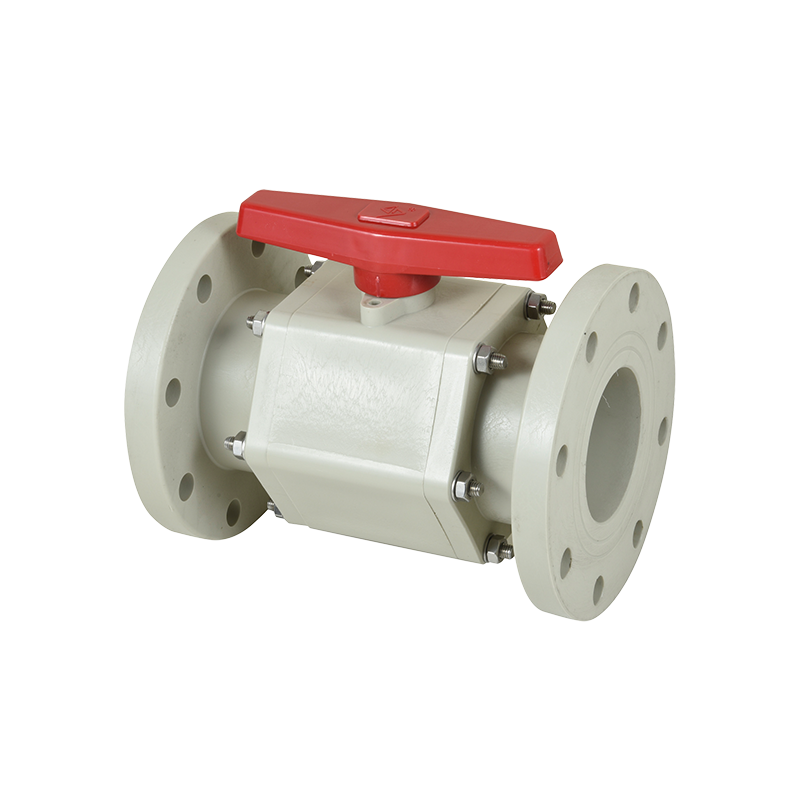 Three-Piece Ball Valve for Fast Repair and High-Temperature ServiceIts swing-out center section allows quick seal replacement without removing end connectors, reducing downtime in critical production lines with demanding conditions.View Product →
Repair or Replace: A Practical Decision Framework
Once a PVC ball valve problem has been diagnosed, the plant team must choose between repair and replacement. The answer depends on the damaged component, the body design, and the criticality of the line. A body crack always requires replacement. There is no safe repair method for a cracked PVC body under pressure, and the affected section of pipe should be inspected for damage as well.
A leaking stem O-ring is worth repairing if the rest of the valve is still in good condition. O-rings, handles, and stem parts are available as maintenance items. If the valve has an internal seal problem and a true union or three-piece body, the seats and ball can be replaced without cutting the pipe. This makes repair economically attractive compared with the labor cost of replacing the entire valve and the two adjacent joints.
For a valve that is more than five years old and has been exposed to outdoor sunlight, replacement is usually more sensible than repair. The body has already lost impact strength, and even a valve with new seats will remain a weak point in the line. The cost of a second failure is much higher than the cost of a planned replacement. In critical service, replacement is also preferred because a repaired valve does not have the same fatigue history as a new one.
Selection of a replacement valve should consider whether the old design was the right one in the first place. A valve that has failed repeatedly from body cracks may need a flanged body instead of a threaded one. A chemical compatibility problem might point to a CPVC or PVDF valve. The replacement is only as good as the specification behind it.
Frequently Asked Questions
How long should a PVC ball valve last in industrial service?
In a clean, chemically compatible medium at room temperature, a PVC ball valve can last more than 10 years. In aggressive chemicals, outdoor sunlight, or high cyclic operation, the service life may fall to two or three years. The practical way to estimate life is to track the valve condition during the first six months and then set an inspection interval that matches the aging rate.
Can a leaking stem be repaired without removing the valve from the pipe?
On a one-piece valve body, the stem seal is difficult to access while the valve is in the line. On a true union or three-piece design, the center section can be removed from the line while the end connectors stay in place, which allows the stem O-rings to be replaced without cutting the pipe. In any case, the line must be isolated and depressurized before the valve is opened.
What is the best way to prevent PVC ball valve body cracking?
Support the pipe on both sides of the valve, tighten all connections to the recommended range using a strap wrench on the body, and avoid closing the valve quickly when the line is moving fast enough to cause water hammer. In addition, never use a handle extension or an oversized wrench on the handle.
Should PTFE tape or pipe dope be used on threaded PVC ball valve connections?
Both can be used, but the sealing mechanism is different. PTFE tape works well when wrapped in the correct direction and applied in two or three layers. Pipe dope should be applied only to the male thread, not into the socket, to avoid the excess being pushed into the valve interior. Sealing is secondary to proper tightening: a PVC thread can tolerate a certain torque range, and exceeding it causes cracking even with perfect sealant application.
What does a true union PVC ball valve mean and why is it useful?
A true union valve has union nuts on both end connectors. When the unions are loosened, the center section of the valve can be pulled straight out of the line. This allows the ball, seats, and stem seals to be inspected or replaced without cutting the pipe or disturbing the threaded or solvent welded joints. It is especially useful for maintenance teams that want to minimize downtime.
Are CPVC or PPH ball valves better than PVC?
CPVC has a higher maximum temperature rating than PVC, typically 93°C versus 60°C, and better resistance to many solvents, oils, and chlorinated media. PPH has excellent resistance to acids and alkalis and is a popular choice for chemical waste lines. The best material depends on the medium, temperature, and pressure of the specific line. PVC is often chosen for general water and dilute chemical service because of its balance of strength, stiffness, and material cost.